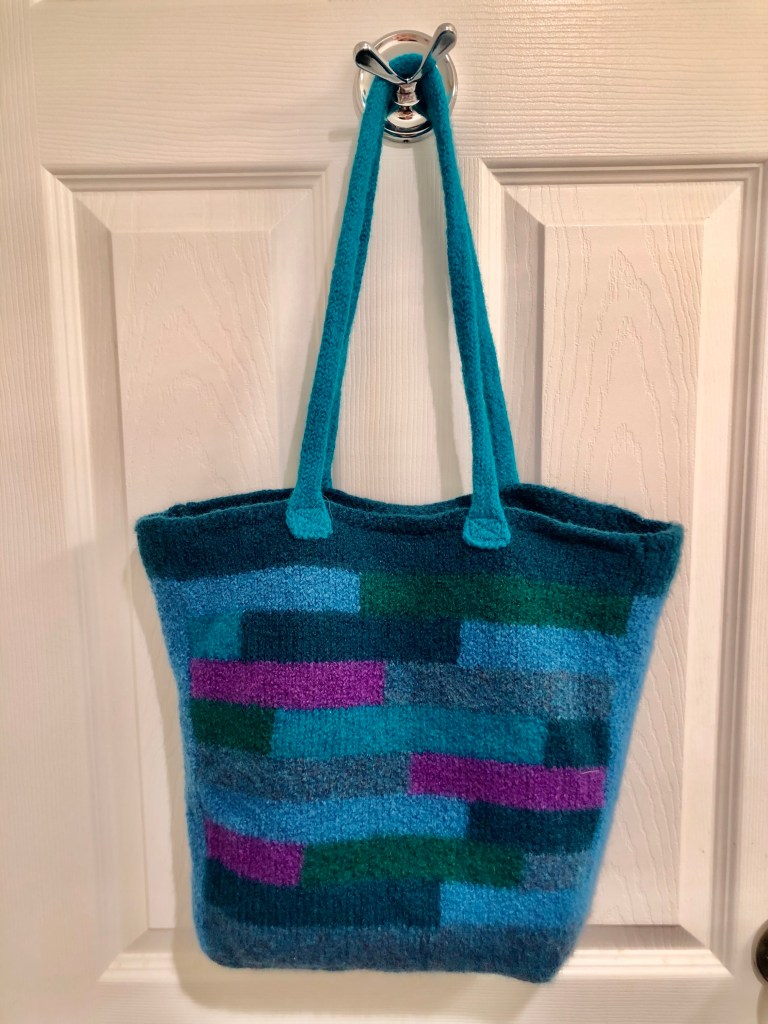
Every now and then, I get an idea to try something new. That’s what happened when I made my first fulled bag. Felting happens when you layer fibre together. Fulling happens when you change the texture a knitted or crocheted item to something that resembles felting.
I knit a colour block bag (Tasche im Patchworkstyle by Gründl Wolle, free on Ravelry), put it through the washing machine several times, sewed on handles, and I was done. I was happy but not thrilled. I could still see some stitch definition. Clearly I didn’t have enough patience to full it enough.
Time for round two.
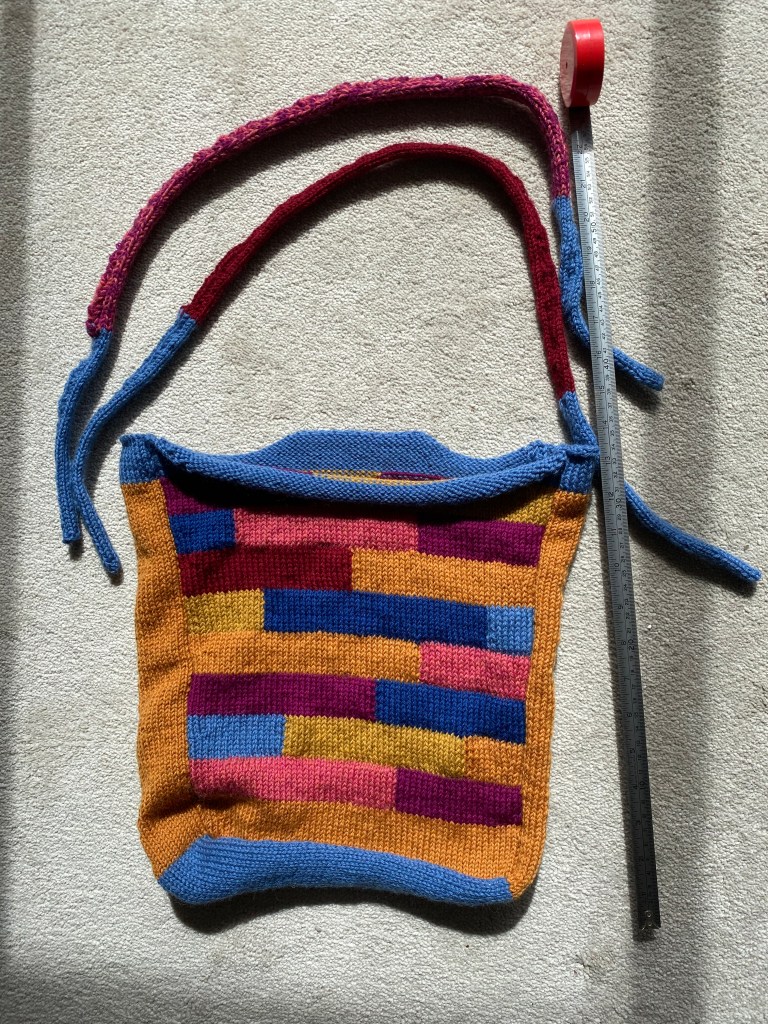
My second bag was to have sunset/desert colours. Again, I chose KnitPicks Wool of the Andes. Not being one to read my previous notes, I knit my second one in Sport weight, rather than worsted. I also did not consult my notes to fully understand how many colours I needed to buy. Perhaps at the time, I thought I could add some of my leftovers from the first project. When it came time to allocate colours, I found some Hollyberry and some lighter blue in my stash — of worsted weight. Guess I’ll learn something about mixing weights of wool.
It’s important to NOT use super wash wool. That’s been treated to prevent felting, making it machine washable. Bleaching also destroys the ability to matt and felt. Similarly cotton and other cellulose fibres don’t matt together and felt. Untreated, unbleached wool works.
Please note that I lost at yarn chicken, and ended up without enough yarn to knit matching handles. I used up the Hollyberry on one handle, and mixed the pinkish and purplish for the other handle. Because this double strand was heavier, I increased my needle size from 3.5 to 4 mm.
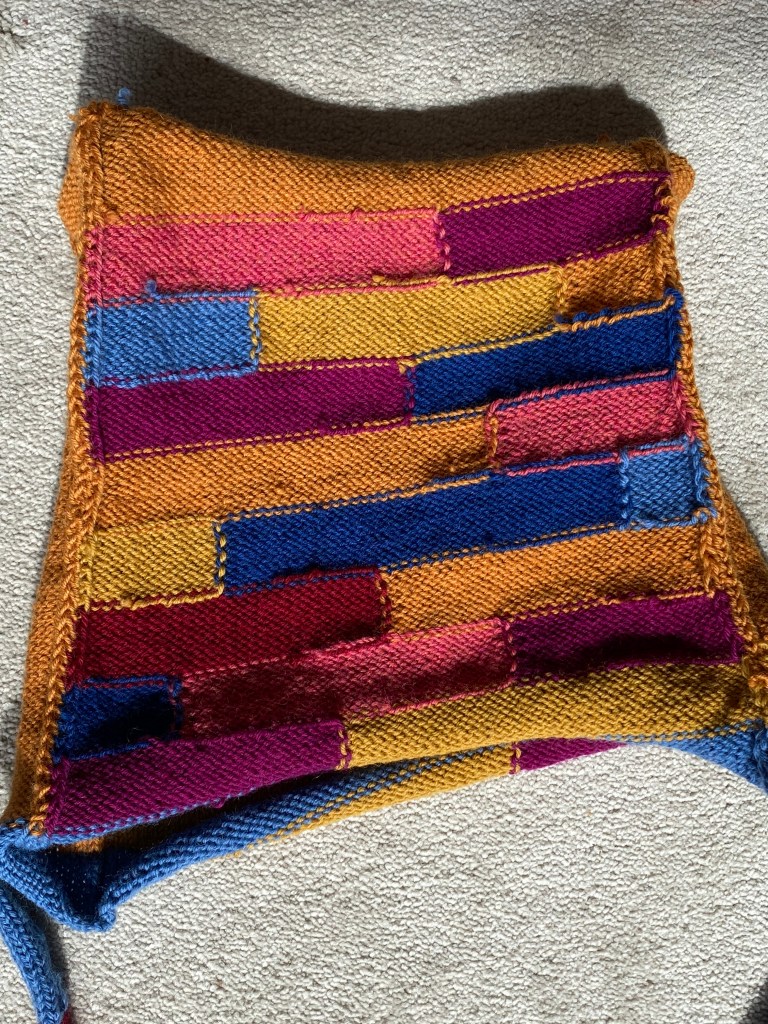
Various instructions said to weave in ends before the fulling process. I was hoping I could get away with the fibres melding, and not having to do this annoying step before proceeding. However, I followed the advice and went ahead.
You might notice the tape measure beside the knitted project. I started out at 13 inches tall for the knit bag. I learned from an earlier experiment that knitted objects become wider and shorter through the fulling process. How much?
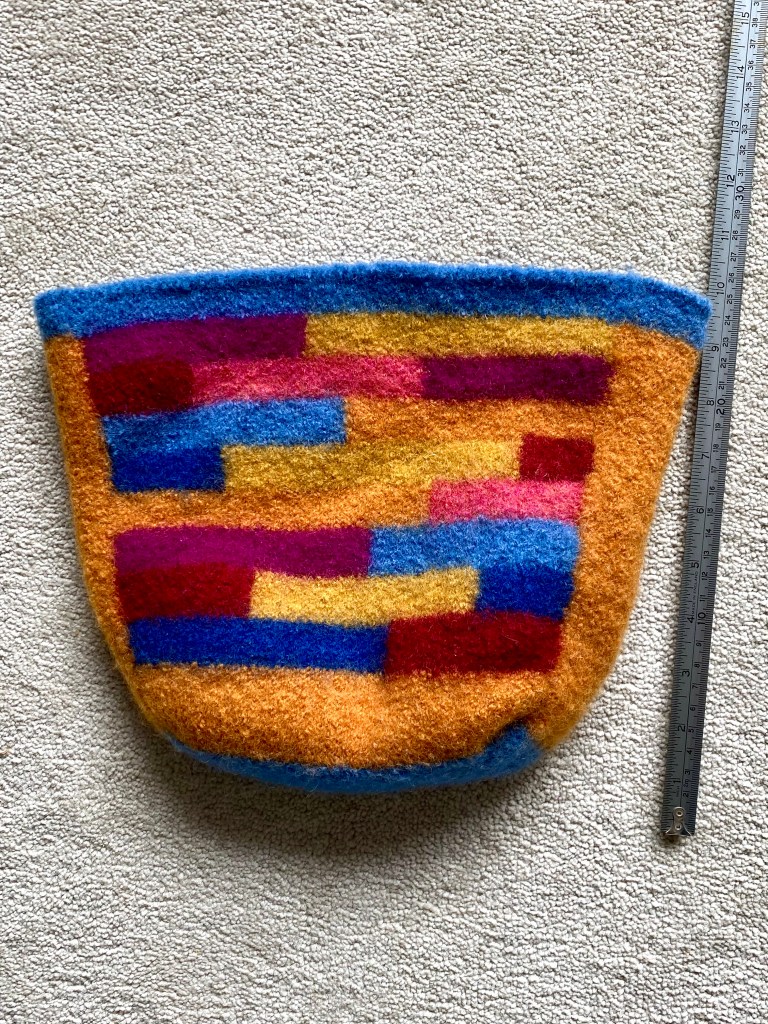
In this case, three inches (23%) shorter!
Fulling process:
Both felting and fulling are processes that make the fibres of wool stick together and form an almost solid surface. It’s accomplished through agitation, detergent and heat. Some people full by stirring with a spatula, spoon or tongs. Others hand full using a plunger. It takes a long time — at least 30 minutes of constant agitation. I have a small washing machine that I can reset between cycles, so I used this.
All three components — agitation, detergent and heat — break down the wool fibres. The detergent strips it of lanolin or other oils or agents that keep fibres separate on the source animal. The heat speeds up the action and the agitation beats out any barriers.
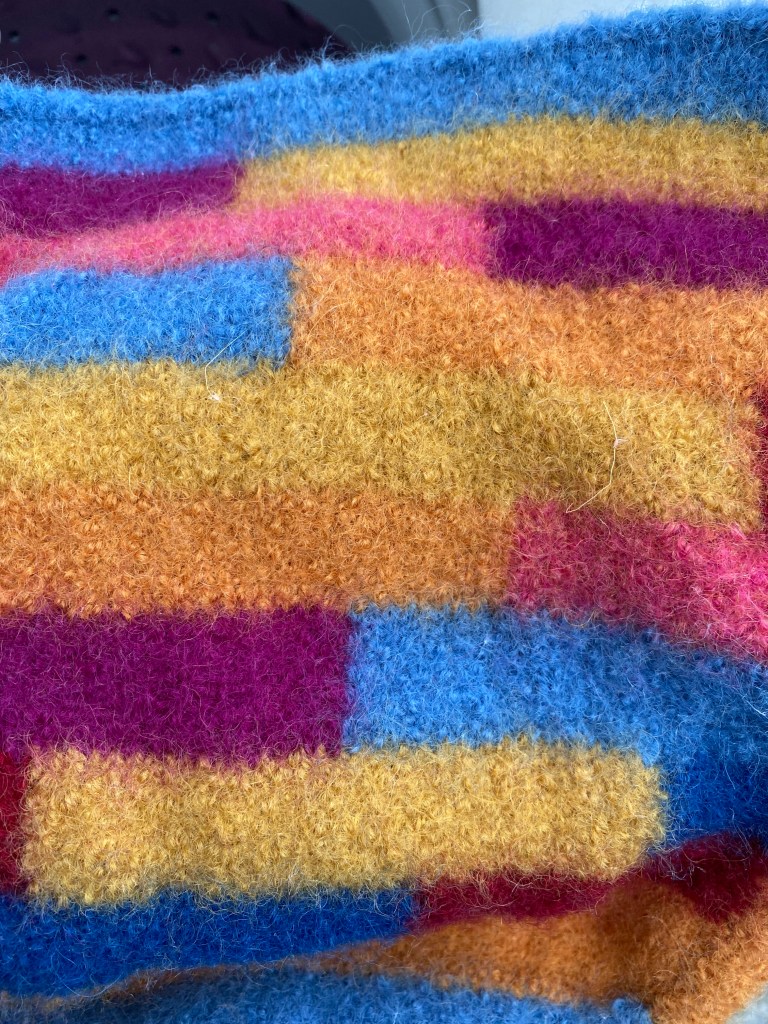
I checked the progress, initially after 20 minutes and then every five minutes to see if I was satisfied by the disappearance of stitch detail. The above photo was at the 30 minute mark. The stitch definition is almost gone, though I can see columns of stitches, especially in the light blue. Back it went for more agitation.
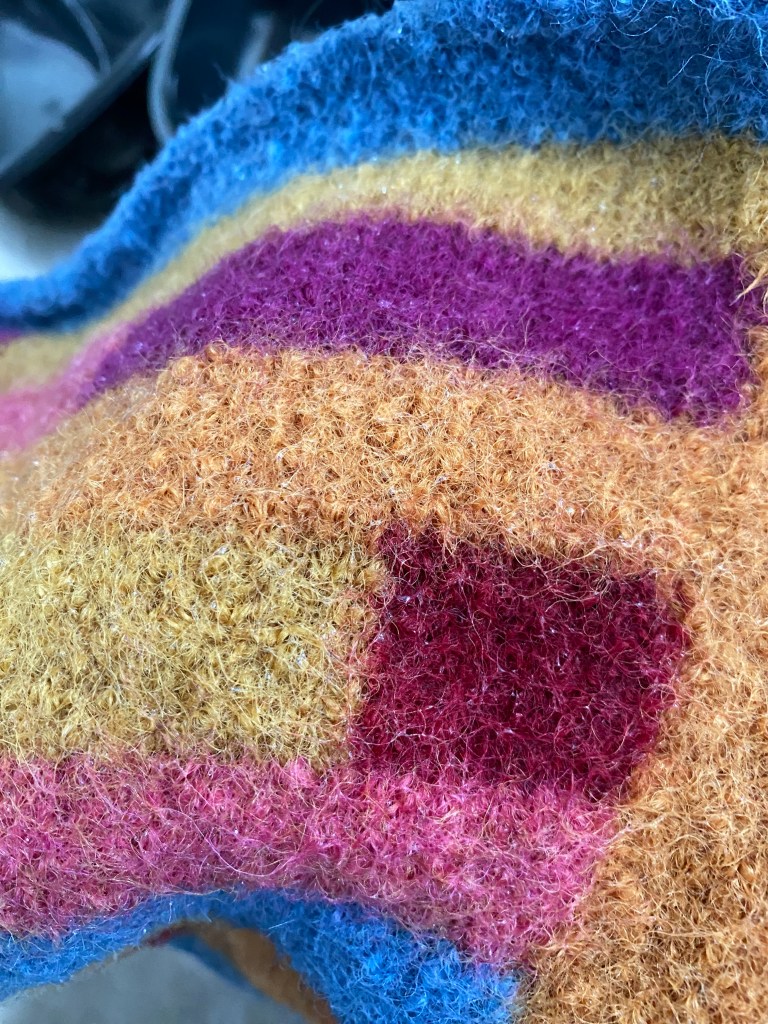
When I was satisfied, I put it through the spin cycle to remove most of the water and to speed the drying process.
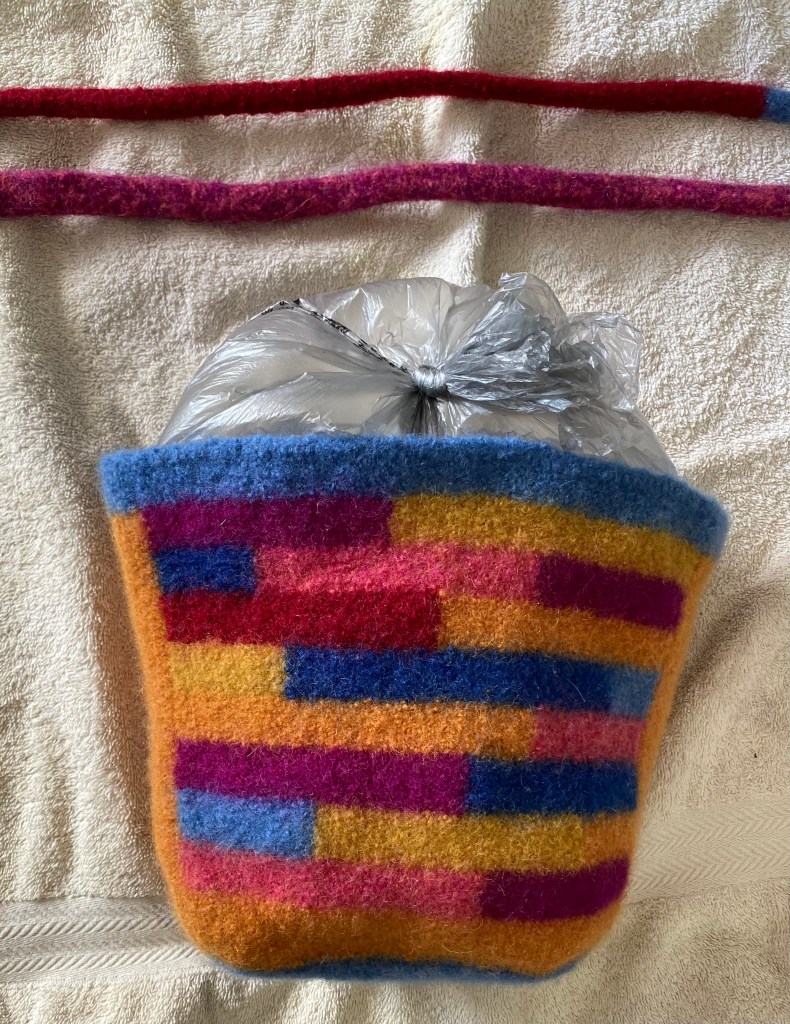
I stuffed it with an inflated plastic bag to give the final product some shape, put it on a towel, and let it dry overnight.
The final step is to sew on the handles. If I wanted to use it as a shopping bag, I might attach some closures. However, it’ll be a project bag for knitting, so I’ll leave the top open.
Did different weights of yarn matter? In the small amount they were used in this project, no. I can feel the difference when I rub my fingers across the patches and adjoining stripes. However, it’s not a significant difference. I used the same needles throughout, so I didn’t have a noticeable size or density difference at the knitting stage. I also strategically used the light blue worsted yarn at the base and the lip, giving these areas more strength.
Did I full too much, shrinking the project? Probably. However, I got the outcome that I was seeking.
Recap:
Fulling is the term to use when you solidify the fibres of a knitted or crocheted item, so that it looks like felt.
Fulling is accomplished by subjecting wool to heat, agitation and detergent. You can agitate manually using a stick, spoon, spatula or plunger, or you can let a washing machine do the work. Every time you subject the knitted project to cold water, you stop the process. For this reason, you want to choose a cycle that does not have a cold rinse or you want to interrupt the washing machine’s progress before it gets to a cold rinse cycle.
Fulling takes time.
Fulling doesn’t work on wool that has been bleached or treated to become superwash.
After the fulling is complete, use the drying time to shape the final item. For a bag, I used an inflated plastic bag. For a bowl, I stretched the wool bowl over a glass bowl. For a hat, I used a balloon inflated to the correct size of head.
What’s next? Maybe some double-knit oven mitts. Maybe a project bag with a picture of some mittens, a sweater or some balls of wool. We’ll see.
 Juliette Knits