What’s the difference between a sample and a swatch, and why make either? Generally to save time and heartache.
Swatching
Swatching gives a knitter an idea of whether their choice of needles and yarn are desirable. The most common reason to swatch (shorthand for knit a swatch) is to determine whether you knit at the same gauge as a pattern writer. This will tell you whether your finished object will fit, or whether you need to adjust your needle size or the pattern.
A swatch is usually a bit bigger than a 10 cm by 10 cm square (4 inches by 4 inches). You can”t get a true determination of your gauge if you include the edges of your swatch, since they can be distorted. Always go a bit bigger. And why a 10 x 10 square? That’s the standard on most ball bands and most patterns.
If your final object is going to be knit in the round, then your swatch should be knit in the round. Most people have different tension when they knit in the round.
A swatch isn’t a swatch until you’ve blocked it (soaked it, shaped it, dried it). This will let you know if the final object will change shape in the block process. Some yarns open up; some yarns bloom; some yarns contract or shrink. It will also let you know whether there are changes to the texture or feel of the yarn. Some yarns soften, some never lose their harshness. It’s something you want to find out before spending many hours on a sweater, only to find it’s too itchy to wear.
It’s always a good idea to swatch, and particularly important if you’re using a yarn that you haven’t used before, or you’re combining strands of two different yarns.
It’s also important to swatch if you’re doing stranded colourwork. You can learn whether you have enough contrast AND you can learn whether your one-colour knitting has a different tension than your two- or three-colour knitting. My colourwork is tighter, so I generally use needles that are 0.5 mm larger on the colourwork sections. Sometimes I need to go up a full millimetre. My most dramatic instance of not-swatching-and-suffering-the-consequences is a hat that I made for a three-year-old and gave to his infant sister.
One expert knitter that I know keeps her swatches in a binder, with notes of the yarn (including colour and dye lot), the pattern and needles used. That way if anyone asks her to reproduce a knitted item (can you please make me a sweater like my niece’s), she can look in her book and get started faster. She never skips the swatching stage. She recognises that her knitting changes over time, as do yarns, and the time spent verifying gauge is less than the time spent remaking a part of the project.
PRO TIP: when making a sweater with pockets, use your swatch(es) as the pocket lining(s).
Samples
When I’m teaching, I make samples. A sample can highlight a technique or a combination of techniques.
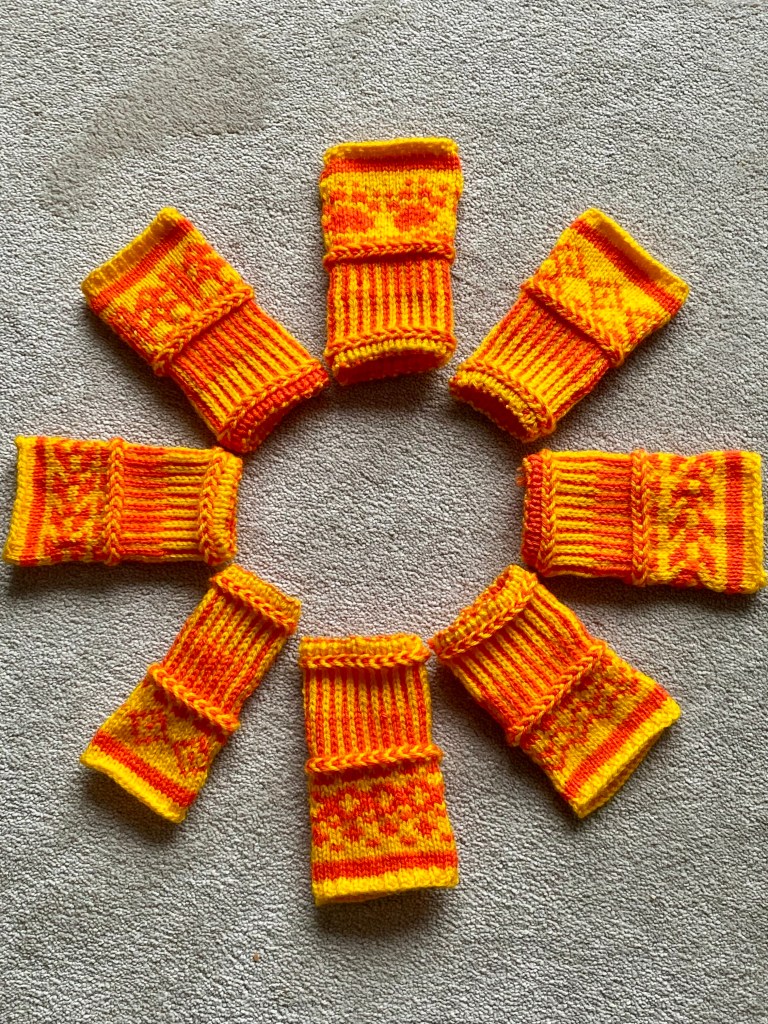
These wristlets show colour dominance. On the inner side of the circle, yellow is the dominant yarn in the corrugated rib. Half way down, I switched the dominant yarn to the orange. I knit many samples because I knew that the participants in this workshop would be sitting at seven tables, and this would give each group something to look at while I was talking about it.
Yarn choice
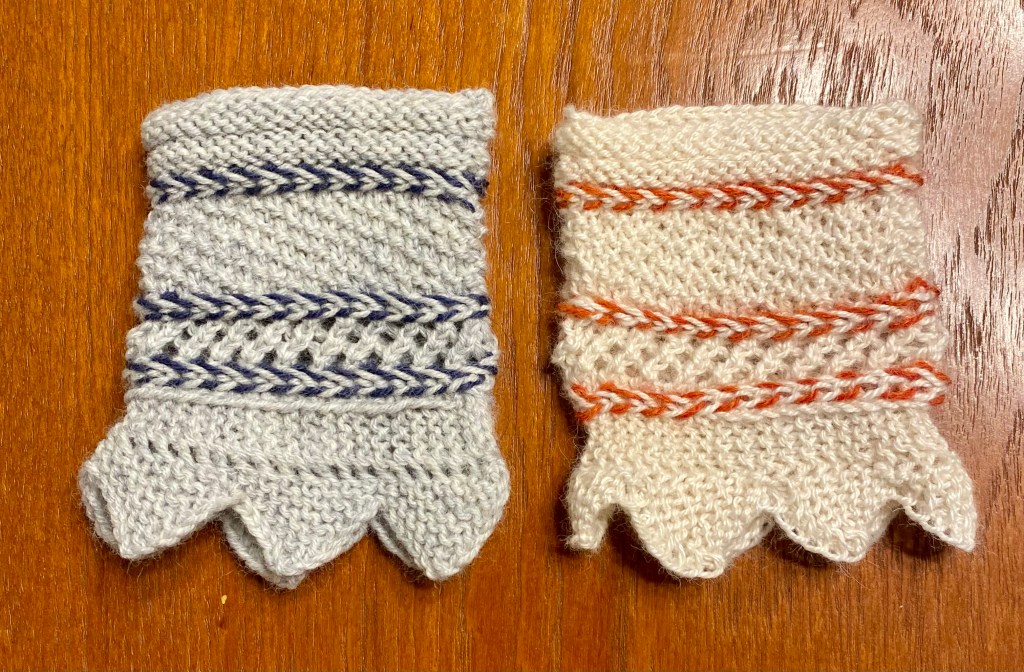
These wristlets show the impact of yarn choice on a project. The yarn on the right is a much used, much beloved Drops Baby Alpaca Silk. I thought it would be perfect to show some techniques used on wristlets, mittens, gloves and hats. It’s soft and springy, and wonderful to wear. It held up well for the scalloped edge and Latvian braid. It lost favour when it didn’t have the stitch definition I was after in the middle section. When I switched to a studier Norwegian yarn (Sandes Garn Sisu), I could easily see the work that went into the object.
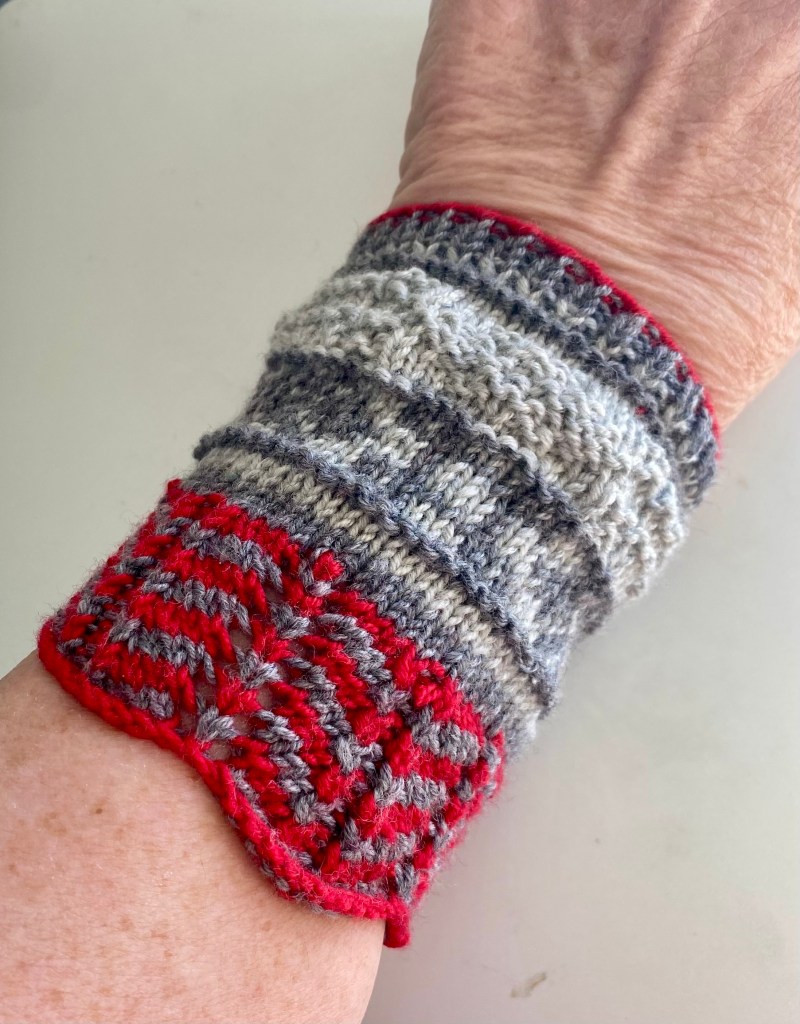
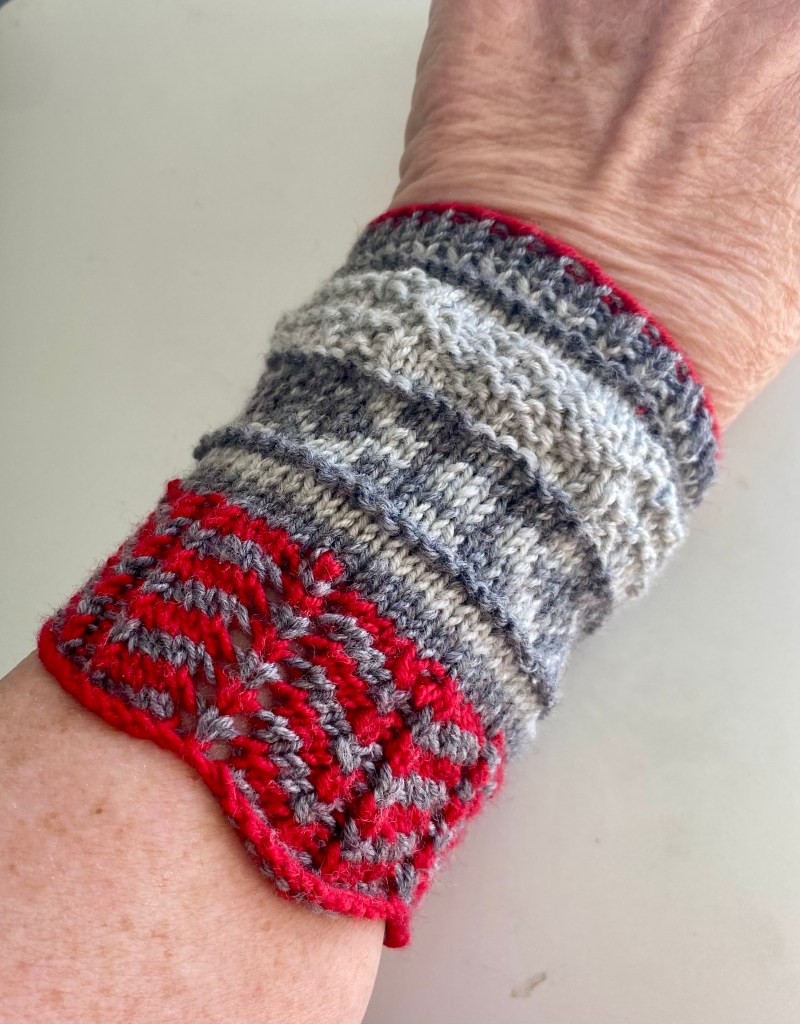
Drops Baby Merino is my go-to for double-knitting, baby blankets, baby hats and many other projects. The contrast is great, it feels good when knitting and it holds up over many washes. However, I learned in this sample that it doesn’t have the stitch definition necessary when adding texture through knitting and purling. The light grey band mirrors the light and dark grey colourwork section. You need more imagination than I have to see the patternwork.
By the way, on this sample, I was reminded of the way a stockinette section will curl at the edge. After casting off half the stitches, I took it back to make a 1×1 rib in the final dark grey section. The red cast-off edge no longer curls.

Sampling tells more than swatching, often because I’m doing more when making a sample. I’ll use samples to experiment. I’ll see whether a combination of techniques work well together or whether I need to go back to the stash cupboard for yarn choice. I often make wristlets because they are quick and easy and I can try them on to get a feel of the yarn.
Sometimes I think of sampling as the next generation of swatching. They are related, and one builds on the other.
 Juliette Knits