
I recently gave a talk on colourwork to the Victoria Knitters Guild, and here are the most significant points.
Colourwork refers to using colour in knitting. It can be as simple as stripes and it can be as complex as double knitting or brioche.
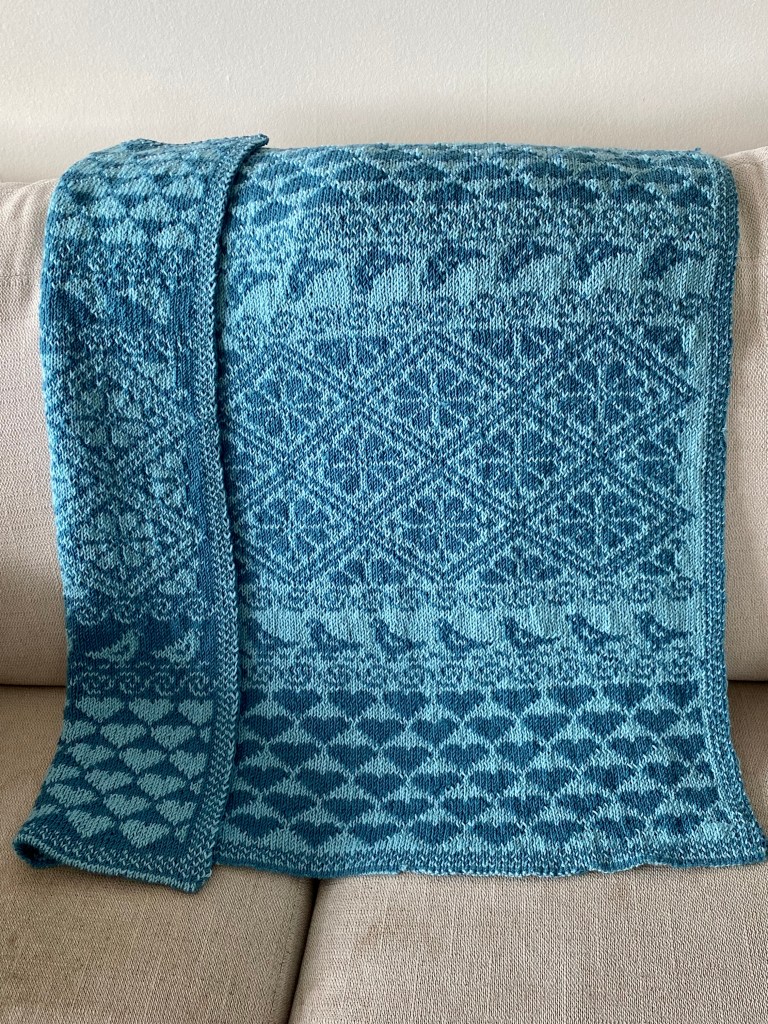
Regardless of complexity, it starts with colour choice. I start with a palette that I like. I steer away from colour theory, though that is strictly personal choice. I like tone on tone, like the double-knit baby blanket above.
Contrast
An undeniable rule of colour work is that you must have yarns that have contrast. I have learned that I can’t trust my eye to identify contrast. I will see ball A and ball B as having contrast because they are different colours. However, when a single strand of ball A is wrapped with a single strand of ball B, the colours might meld and the contrast disappears. For this reason, I always take a black and white picture of my chosen yarns.

This blue and raspberry look bright and cheery together.
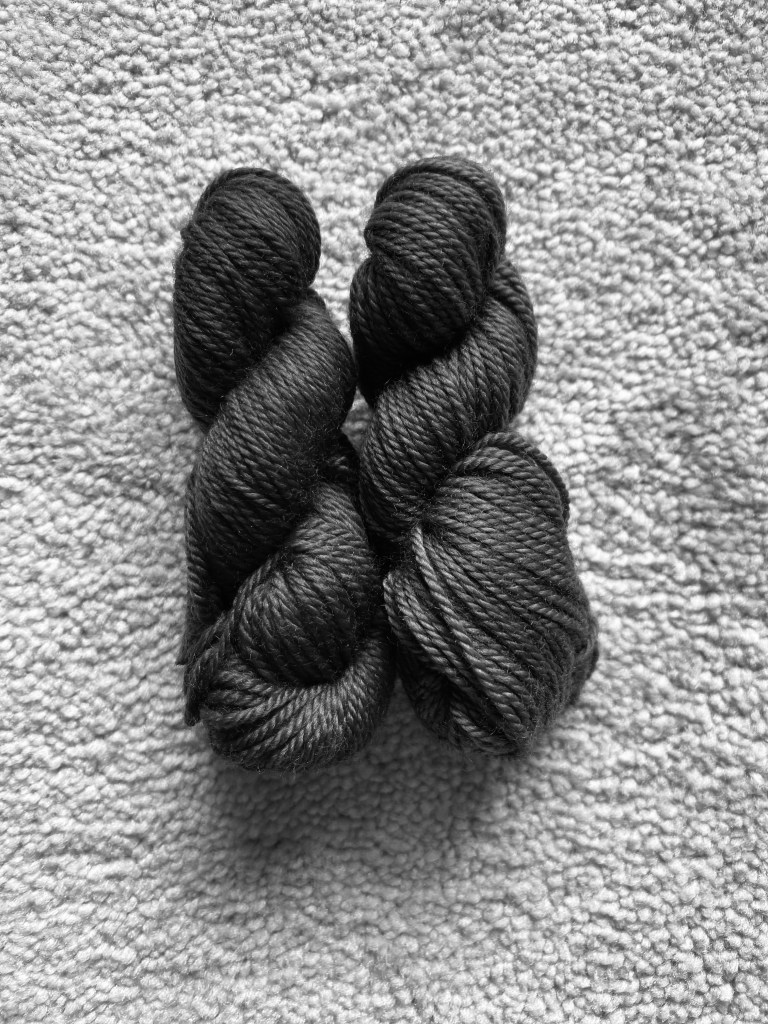
In black and white, there is very little difference between the skeins, so they won’t make a good pairing — unless a third colour is added to break them apart.
Colour Dominance
Colour dominance is commonly thought of as the colour that is more dominant to the eye. In most patterns, the dominant colour is the contrast colour (CC) and the other is the main colour (MC).
To accomplish the dominance of a colour, you have to figure out the look you are going for AND you have to hold your yarn to get this look.
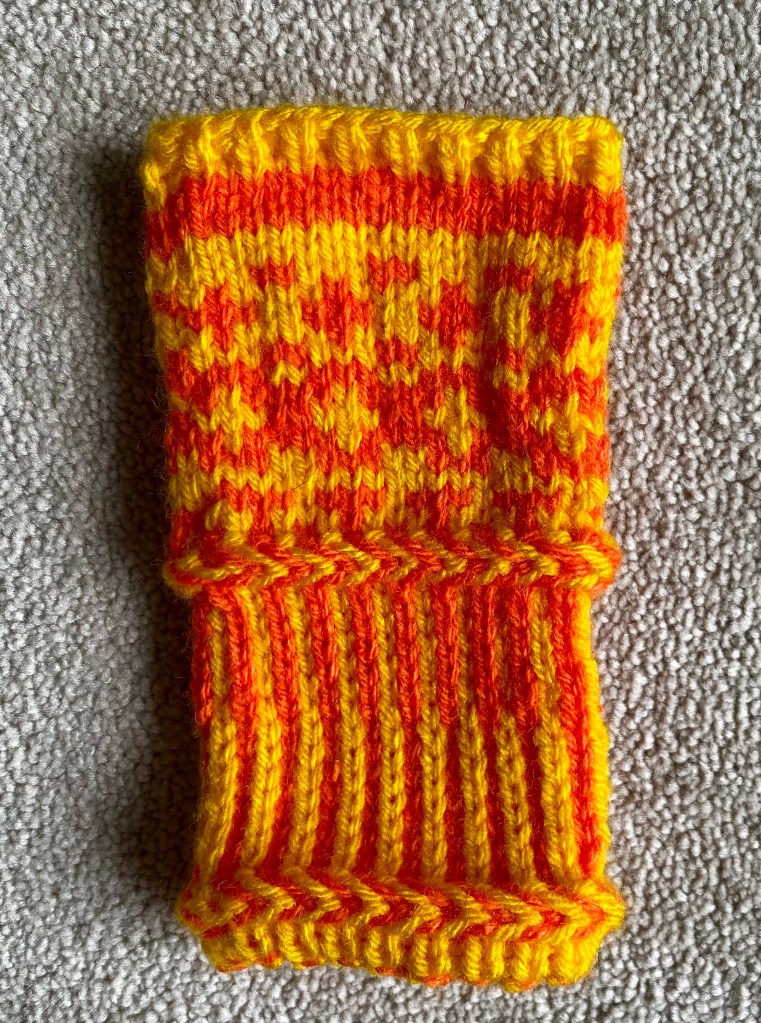
I often use this yellow and orange combination of colours in teaching. It’s easy to see what’s going on, and it’s easy to see when you’ve gone wrong. I might use this colour combination for a pair of mittens that I’m likely to misplace — it’s easy to spot from a distance.
On to the point that I want to make with this sample. In the upper section, the pattern is the same. However, for some reason, I don’t see the pattern as being the same with the yellow crosses and the orange crosses. The yellow is more dominant to my eye. Yet the pattern shows up much more when the orange is the background colour (MC) and the yellow is the contrast colour (CC).
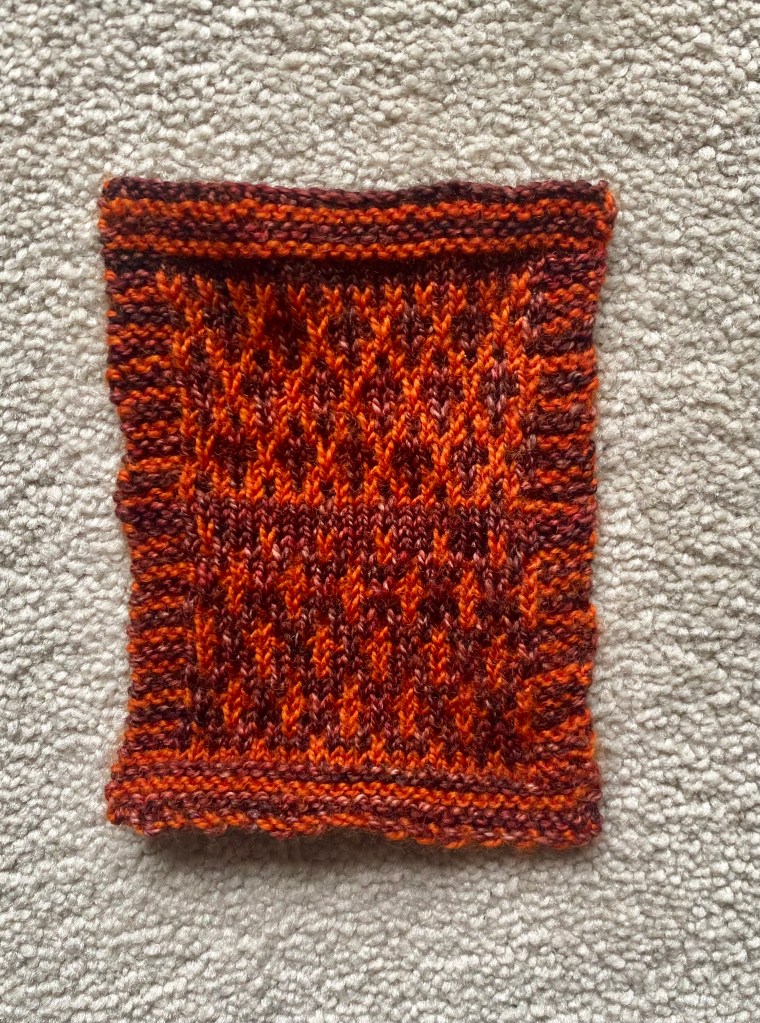
It’s the same with the mosaic swatch. The yarn is the same, the needles are the same, the pattern is the same, yet the top and bottom look different. Swatching gave me an idea of how the colours act together.
Secondly, with colour dominance, the dominance is achieved through the way the yarn is held and carried. I knit Continental, with both yarns in my left hand. I put the dominant colour below (closer to my wrist) the main colour (closer to my fingertips), and pick it up accordingly. My knitter friends who follow the English style of knitting hold the dominant colour (CC) in their right hand and the background colour (MC) in their left hand.
The vertical stripes in the orange and yellow wristlet above show the difference in dominance most vividly. Close to the bottom of the cuff, I held the yellow yarn below, making it dominant. Then half way through the striped part, I held the orange yarn below, changing the dominance. In the bear paw wristlet in the very first picture (the circle of samples), you can see where I inadvertently picked the yellow to be dominant a few times in the orange-dominant section.
In those samples, I followed the top-bottom rule of colour dominance in the upper (non-striped) part. It is most obvious in the single-cuff picture. However, if you look carefully, you can see the impact of the way I held my yarn.
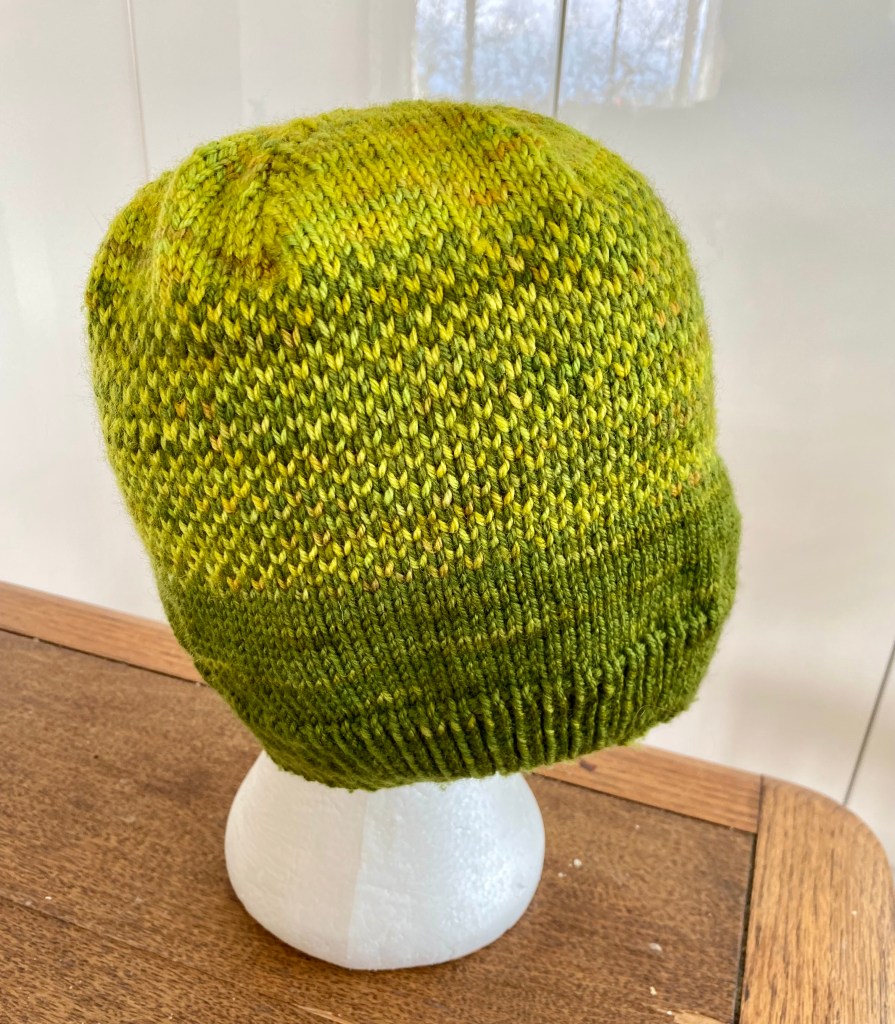
Sometimes, as with this Brighton Hat by Megan Nodecker knit in two shades of Dream in Colour green, colour dominance barely shows up. I wondered why I went through all that trouble.
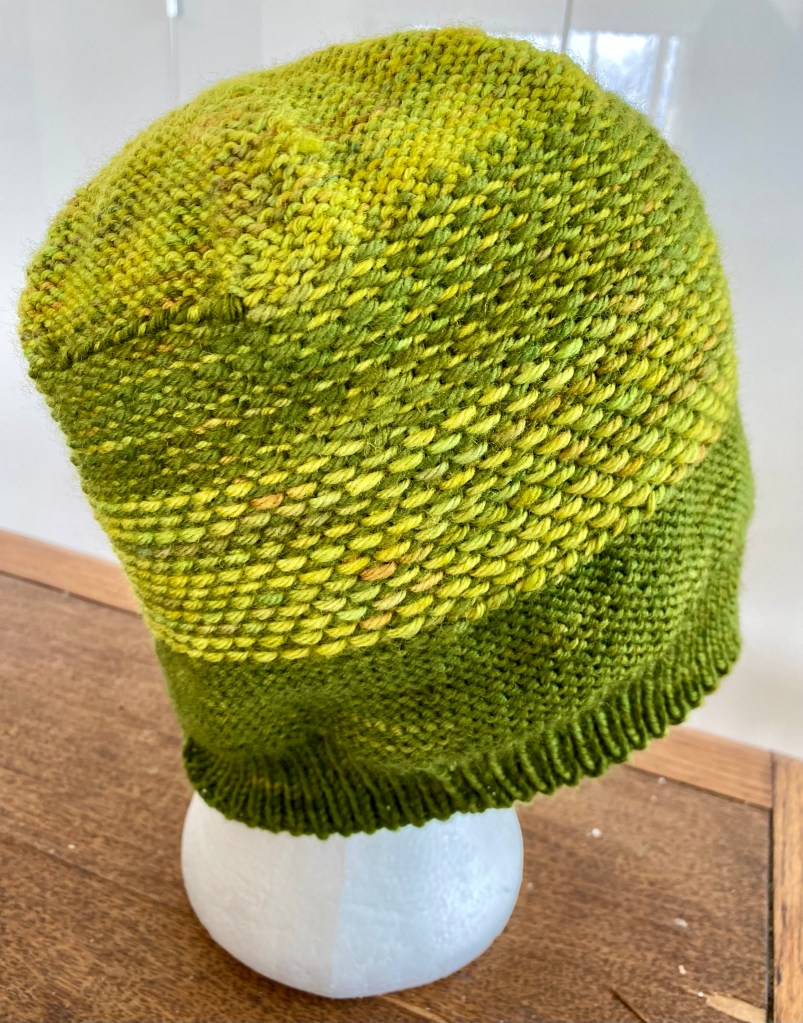
Then I checked the backside of my piece, and it all became clear.
Tension
Tension in colourwork is impacted by the size of the yarn, the size of the needles and whether the two (or more) colours are used in one row. If you are knitting stripes, use the needles recommended on the ball band or the project. With stranded knitting, I usually increase my needle size by .5 mm or .75 mm. The exception is double knitting. Good pattern writers will tell you to do this. Unfortunately, not all pattern writers remember.
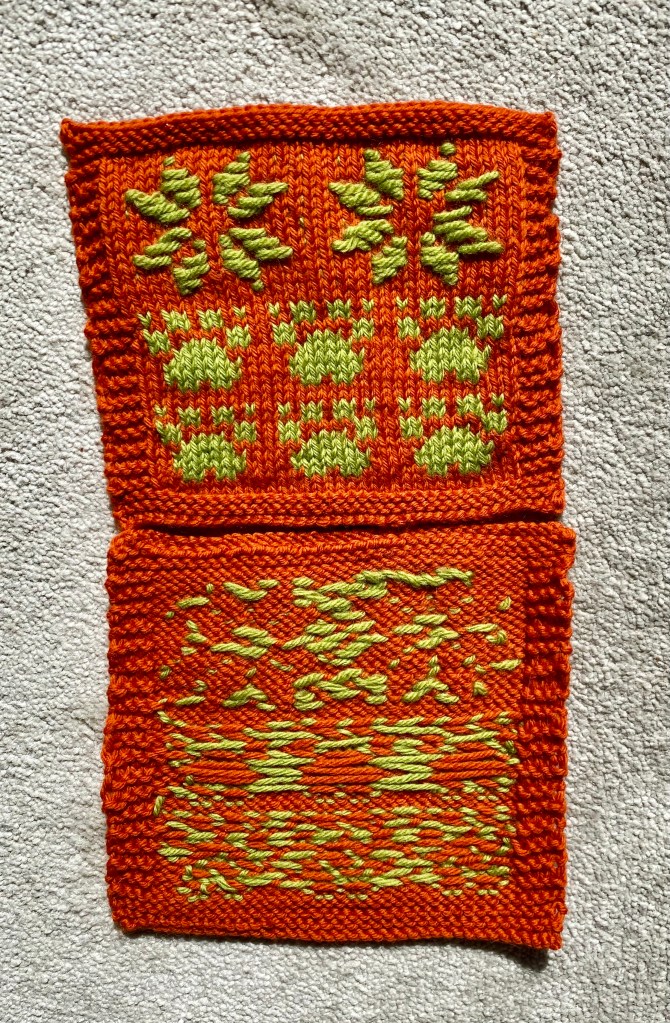
When stranded knitting, I am carrying a yarn behind my work. When I pick it up to use it, I try to keep the float (the unused yarn behind) at the same tension as the front — I try to pull it so that it covers the same distance as the worked yarn on the surface. In the orange and green sample above, the paws are stranded colour work and the stars are inlay. The top swatch is the front side, and the bottom swatch is the backside. In the middle, section of the bottom swatch, you can see how the unused yarn floats across the work.
One way to to prevent distortion of the final object is to catch your floats. Sometimes when putting on a knitted item, a finger might catch in a float. Naturally, you try to remove your finger, and in doing so, you might pull the floating yarn. Inadvertently, you distort your hat, mittens or sweater. Oops.
Catching your floats also helps to maintain your tension. The unused yarn is kept near to the tension of the worked yarn. To catch floats, wrap the unused yarn around the working yarn on the backside before a worked stitch. Avoid stacking these catches floats — they will peek through the right side if you do this. Don’t wrap it all the way around. Just pick it up to that it tucks into the worked yarn. Easier to do than to describe.
I like to catch my floats every third stitch. If I have a block of stacked changes — maybe a six stitch by seven row square — I’ll alter the point where I pick up. For example, I’ll pick up the float on the third stitch on the first row, on the second and fifth stitch on the second row, on the first and fourth stitch on the third row, on the third stitch on the fourth row, etc.
Carrying in front
Sometimes, you’ll want to carry your yarn in front for effect. In the orange and green swatch above, I’ve shown how carrying yarn in front results in Inlay. It’s most effective in a dense fabric with floats of two to three stitches.
As with colour dominance, it’s important to carry your floats consistently when creating an inlay. I often carry my yarn underneath the working stitch. With inlay, I reminded myself to carry it forward atop the most recent stitch. If I brought it forward atop the stitch and brought it back below the stitch, the inlayed/carried yarn would slant. It would look messy.
Another time to carry yarn in front is when making a Latvian Braid. The yellow and orange wristlets at the top of this page have a set of Latvian Braid before and after the vertical stripes. It’s one of my favourite embellishments. It’s very easy to accomplish and looks wonderfully impressive.
To make a Latvian braid, purl in alternating colours, instead of knit, on the right side of your project. Carry the yarn on the right side. I always carry it below on the first row and above on the second row. It doesn’t matter whether you go under first and above second. It matters that you are consistent. There are many YouTube videos that show how to make a Latvian Braid.
Mosaic/slip stitch knitting
Mosaic knitting is a way of establishing a colour pattern without carrying your second yarn. It’s knit in stripes, and slipping stitches to create the impression of intertwined colours. Andrea Mowry has many well written mosaic pattern available on Ravelry.
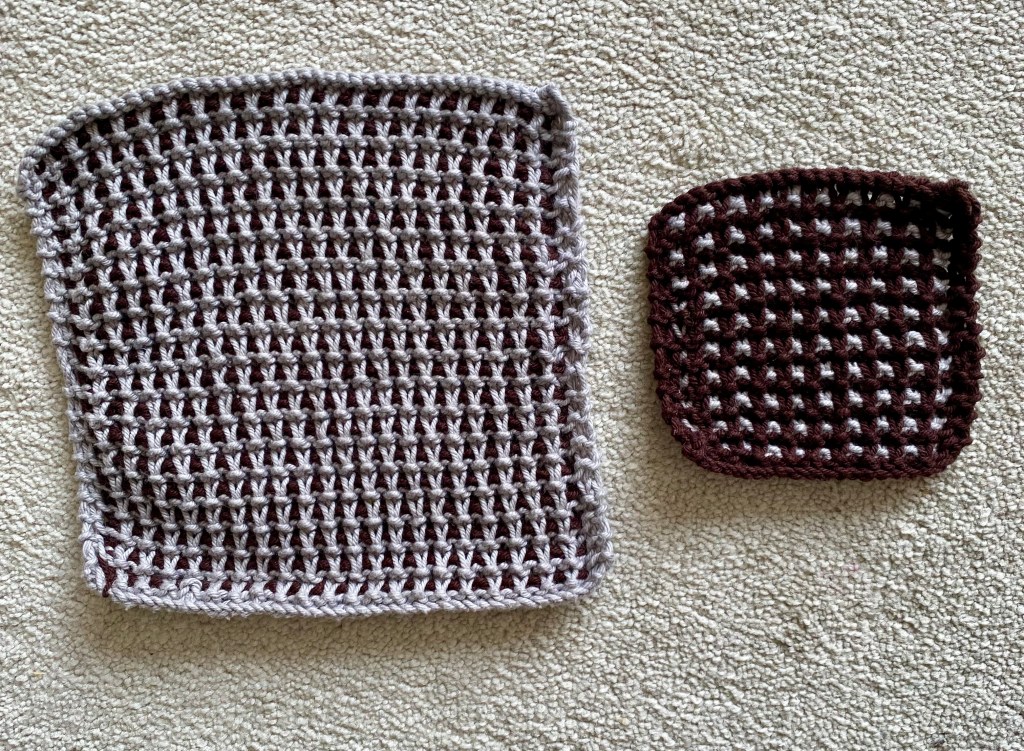
As I was exploring colour dominance, I was surprised by the way colours expressed their dominance in mosaic knitting. The slipped colour is more dominant in the trivets. That was not the case in the orange and brown swatch far above. This is a very good reason to swatch before committing yourself to a project that is larger than a coaster.
Yarn selection
In all the swatches and samples illustrated above, I happened to use two colours of the same yarn. This is rare for me. I usually go to my stash cupboard and pick two yarns that I think might work and take a photo to check their contrast. My stash cupboard is organised by weight of yarn, so I know that if I pick from any shelf, all the yarns in it are likely to be compatible. I still check my band labels to see if the recommended gauge is the same.
Many decades ago, when I knit Lopi sweaters, I’d add a skein of handspun to the yoke to provide more texture and colour interest. That ball band of that handspun skein would show the same gauge as the Lopi yarn.
In recent years, I’ve focused on knitting hats, mittens, sweaters and baby blankets. Whenever I mix my yarns, I check the gauge. Most of the time, it works out.
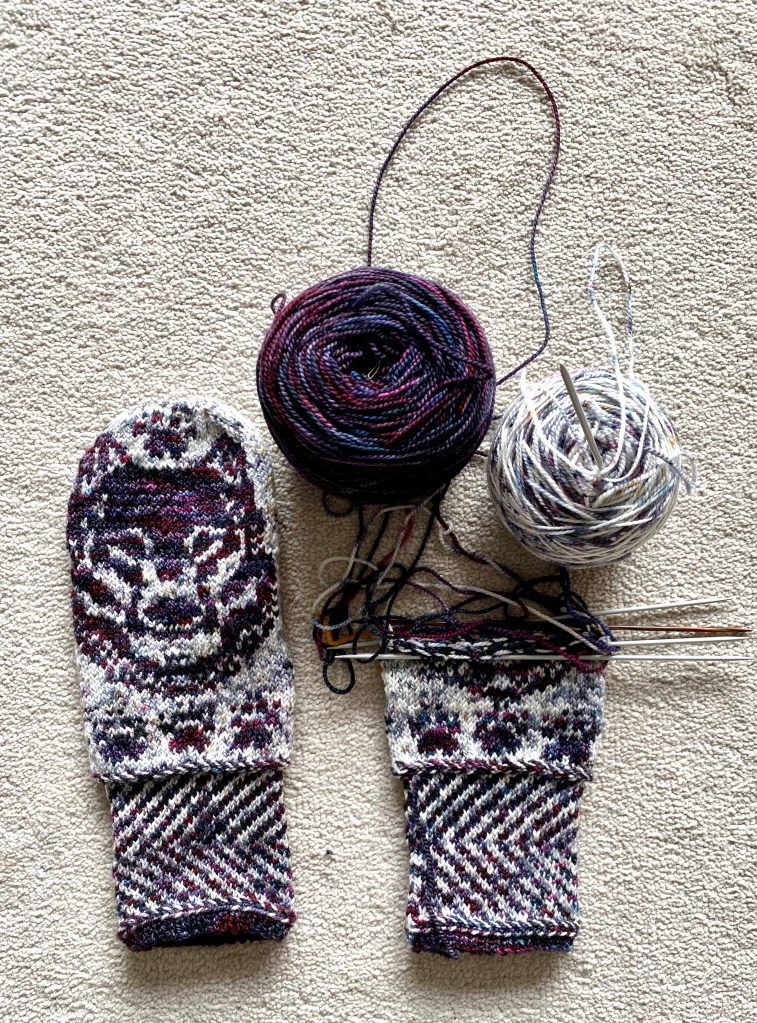
Sometimes, I learn the hard way. One such lesson was a pair of Elkhound Jämthund Mittens by Connie H Design. I knit the first pair in solids. They were great. For the second pair, I selected some yarns with similar speckles. Big mistake. The speckles sometimes got in the way of the detail.
Bottom line: it’s okay to use a novelty yarn, such as something with texture or speckles. It’s important to pair it with a solid, not another novelty yarn. Unless that’s the look you’re going for, of course.
Regarding the texture of yarn, some knitters encourage the use of a grippy yarn for colourwork. By grippy, I mean something that is going to make stitches cling to each other. This could also be described as rough or hairy. While this helps to hide floats, it can also make a garment uncomfortable to wear. A fine spun merino or cashmere blend is great in colourwork, even though it looks smooth.
I really like making children’s toys and clothes in Sirdar Baby Bamboo yarn. It’s 80% bamboo sourced viscose and 20% wool, and has a beautiful sheen. Compared to Shetland or Lopi yarns, it’s slippery. However, it behaves wonderfully in colourwork.
When choosing your yarn, think more about how it will behave than how grippy it is. Will the yarn have too much drape, and fail to hold its shape. Does it need a proportion of wool to provide elasticity? Does it need to be machine washed every week (in which case, you’ll probably choose an acrylic)? How does it feel in your hands? Colourwork tends to a take a bit more time than a plain item, so you’ve got to be comfortable holding the yarn while knitting the item. If the yarn is itchy or scratchy, you may not want to hold it and someone is unlikely to want to wear it.
Swatching
Many knitting masters will tell you that it’s important to swatch. I have always smiled, nodded and started my project regardless. If I didn’t like the way it was turning out, I would rip it apart. However, by seeing how colours respond to each other in the pattern and the technique used as I prepared this talk, I have become an advocate of swatching.
Start small
It’s a good idea to start colourwork with a small project, like a cowl or a pair of wristlets. You have the advantage of finishing quickly, and it’s a low-risk investment of supplies. When I started making double-knitting, I started with coaster-sized squares before graduating to baby blankets. I honed my techniques, then dived into challenging work.
 Juliette Knits